
Calling someone in another country can feel surprisingly complicated when a perfectly normal phone number suddenly grows a + sign, extra digits, and a small collection of numbers that look like they belong in a spy movie.
The good news is that international calling codes are much easier to understand once you know what each part of an international phone number does. A country calling code tells the telephone network which country you want to reach, while the remaining digits identify the specific phone number. International numbering is standardized through the ITU-T E.164 framework.
The basic process is simple: identify the destination country, find its calling code, use your country's international access method when necessary, and then dial the destination number in the correct international format. For example, India uses +91, the United Kingdom uses +44, Australia uses +61, Germany uses +49, and Japan uses +81.
The tricky part is that dialing procedures can vary depending on where you are calling from and what type of number you are calling. Some countries also use shared numbering arrangements, such as the North American Numbering Plan, where multiple destinations use country code +1 with additional area codes.
This guide breaks the whole process down into simple steps so you can make an overseas call without staring at your phone wondering whether that extra zero is supposed to be there.
What Is an International Calling Code?
An international calling code, also called a country calling code, is the numerical prefix used to identify a destination country when making an international call. These codes generally appear after the + symbol in an international phone number. For example
- +1 — United States and Canada
- +44 — United Kingdom
- +91 — India
- +61 — Australia
- +33 — France
- +49 — Germany
- +81 — Japan
- +86 — China
- +971 — United Arab Emirates
Phone Number Wizard maintains a comprehensive reference of international calling codes covering countries and territories around the world.
The country code is different from an area code. A country code identifies the country or numbering destination, while an area code generally identifies a geographic region or numbering area within a country.
For example, when calling an American number internationally, +1 identifies the North American numbering system, while the following three digits may identify a particular area code.
How International Calling Codes Work
An overseas phone call usually contains several pieces of information. A simplified international number can look like this:
+91 98765 43210
Here:
- + indicates international dialing format.
- 91 is India's country calling code.
- 98765 43210 is the national phone number.
The exact structure varies by country because national numbering plans are not identical. ITU-T E.164 defines the international numbering framework, including country codes and the structure of international numbers.
Think of the number like an address - the country code gets the call to the right country and the remaining digits help the telephone network locate the intended subscriber.
Without the correct country code, the network may not know where your call is supposed to go. Your phone isn't being difficult; it simply doesn't have enough directions.
Step 1: Find the Country Calling Code
Before making an overseas call, identify the country where the person or business is located.
Then find that country's international calling code.
For example:
Destination | Country Code |
United States | +1 |
Canada | +1 |
United Kingdom | +44 |
India | +91 |
Australia | +61 |
Germany | +49 |
France | +33 |
Italy | +39 |
Spain | +34 |
Japan | +81 |
China | +86 |
Singapore | +65 |
South Korea | +82 |
United Arab Emirates | +971 |
South Africa | +27 |
You can use the Phone Number Wizard International Calling Codes reference to look up the correct code before dialing.
Be especially careful with destinations that share a country code. The United States and Canada, for example, both use +1, while several Caribbean destinations also use +1 followed by additional digits.
Step 2: Use the International Dialing Prefix When Required
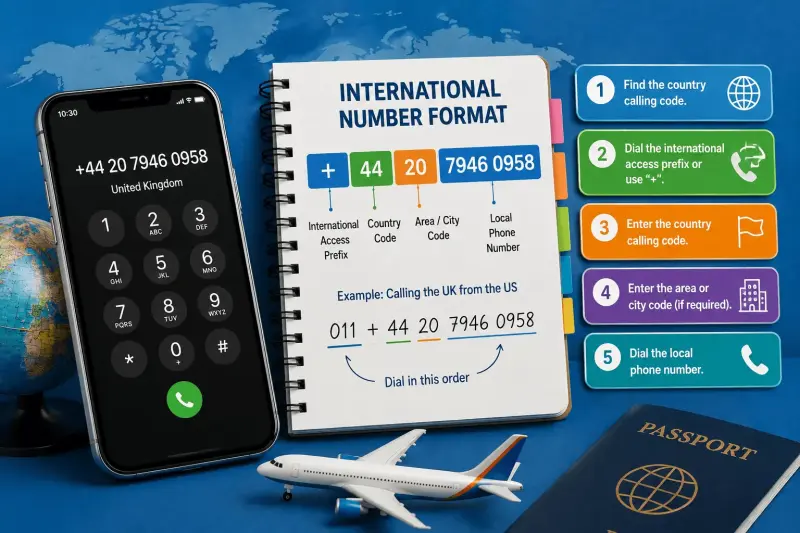
The + symbol is a convenient way of representing the international access portion of a phone number. When dialing manually, some phone systems require an international access code, sometimes called an international dialing prefix or exit code, before the destination country code. The exact prefix depends on the country you are calling from and the telephone service you are using.
For example, from the United States, the international access code is commonly 011 for traditional international dialing. A call to the UK can therefore be represented as:
011 + 44 + destination number
On a mobile phone, however, you can often enter the number using the + format:
+44 + destination number
This is one reason saving contacts in international format is so useful. Instead of remembering which international access code to use every time, you can store the complete number beginning with +.
Step 3: Add the Destination Country Code
Once you've established the international dialing portion, add the destination country's calling code.
For example, India's country code is +91.
So an Indian number might appear internationally as:
+91 98765 43210
A UK number might begin:
+44 ...
An Australian number might begin:
+61 ...
A German number might begin:
+49 ...
The country code is one of the most important parts of the number, so double-check it before calling. One wrong digit can send your call somewhere entirely different—or nowhere at all.
Step 4: Enter the National Phone Number Correctly
This is where international dialing gets a little sneaky. A phone number written for domestic use may include a national or trunk prefix that should not be included when dialing internationally. The ITU specifically notes that the destination country's trunk prefix should not be dialed as part of an international call.
For example, a domestic number might be written with a leading 0, while the international version removes that zero and uses the country code instead.
A simplified example:
Domestic: 09876543210
International: +91 9876543210
The exact rules depend on the country's numbering plan, so don't automatically remove or keep a leading zero without checking the destination country's dialing format. This is one of the most common reasons an international number fails even when the country code itself is correct.
Step 5: Dial the Complete International Number
Once you've assembled all the required parts, you're ready to make the call.
Using the common + format, the structure looks like:
+ [Country Code] [National Number]
For example:
+91 98765 43210 or +44 20 XXXX XXXX
The spaces are generally there to make the number easier for humans to read. The actual dialing system handles the digits according to its numbering rules. On most modern smartphones, you can enter the + symbol by pressing and holding the 0 key on the phone keypad. And just like that, you've graduated from “international dialing looks terrifying” to “international dialing is mostly just numbers wearing a fancy hat.”
How to Call Another Country From the United States
If you're calling internationally from the United States, a traditional dialing pattern is:011 + Country Code + National Number
For example, a simplified call to India could be represented as:
011 + 91 + Indian number
A call to the UK could be:
011 + 44 + UK number
A call to Australia could be:
011 + 61 + Australian number
Alternatively, on a mobile phone, the international format can generally be entered using +:
+91 ... or +44 ... or +61 ...
The exact dialing method can depend on your carrier, device, and calling service, so check your provider's instructions if a call does not connect.
How to Call the United States From Another Country
To call a US number internationally, use the United States country code:
+1
A simplified international format is:
+1 [Area Code] [Local Number]
For example:
+1 212 555 1234
The +1 identifies the North American Numbering Plan, and the following digits help identify the specific destination. The United States is one of several destinations associated with the +1 numbering system.
This is why seeing +1 alone does not always tell you that a number belongs specifically to the United States.
How to Call India From Another Country
India's international calling code is:
+91
A typical international-format Indian mobile number looks like:
+91 98765 43210
If you're calling India from another country, enter your international dialing prefix or use the + format on a mobile phone, followed by 91 and the appropriate Indian number.
The Phone Number Wizard country-code reference lists India as +91.
When converting an Indian number from a domestic format to an international one, pay attention to whether the original number contains a leading national prefix.
How to Call the UK From Another Country
The United Kingdom uses:
+44
An international-format UK number might look like:
+44 20 XXXX XXXX
or:
+44 7XXX XXXXXX
When converting a UK number from domestic format, the leading 0 commonly used in domestic dialing is generally omitted after the +44 country code.
However, always verify the number's correct format rather than applying the same rule blindly to every international number. National numbering plans differ.
Common International Calling Mistakes to Avoid
1. Using the Wrong Country Code
This is the most obvious mistake—and surprisingly easy to make.
Always verify the destination country before dialing. Phone Number Wizard's international calling code directory provides country-by-country codes in one place.
2. Keeping a Leading Zero When You Should Remove It
Some countries use a leading 0 for domestic or trunk dialing.
That zero may not belong in the international version.
Don't assume, though. Check the destination country's dialing rules first.
3. Forgetting the International Access Code
If you're manually dialing from a landline or a system that requires an international access prefix, you may need to enter it before the country code.
Mobile phones often make this easier by supporting the + format.
4. Confusing Country Codes With Area Codes
A country calling code and an area code are not interchangeable.
For example:
+91 = India country code
An area or local numbering component comes afterward.
Mixing these up can turn a perfectly good phone number into a numerical disaster.
5. Copying a Number Without Checking Its Format
Phone numbers appear in many formats:
+91 98765 43210
0091 98765 43210
091 98765 43210
9876543210
These may represent the same number in different contexts—or they may not, depending on the country and dialing conventions. Before calling, determine whether you're looking at a national number, international number, or formatted version.
Why Saving Contacts in International Format Helps
If you regularly call people in other countries, save their numbers in international format.
Instead of saving:
09876543210
save the number in an appropriate international format, such as:
+91 98765 43210
This can make international calling much easier when you're traveling or switching between networks. It also reduces the chance of accidentally using a domestic dialing format when you're outside the country.
For businesses with international customers, maintaining phone numbers in a consistent international format is even more important. It makes customer records, CRM systems, contact databases, and communication tools easier to manage.
What Is E.164 Phone Number Format?
If you've worked with international phone numbers in software, databases, or business systems, you've probably encountered E.164.
E.164 is an international numbering recommendation from the International Telecommunication Union that defines the structure of international telephone numbers. The current ITU-T E.164 material covers the international number structure, country-code assignment, national significant numbers, and related numbering resources.
A simplified E.164-style number looks like:
+919876543210
Notice that there are no spaces, parentheses, or unnecessary punctuation. This format is particularly useful when phone numbers need to be stored or processed consistently by software.
For everyday human use, however, a formatted version such as:
+91 98765 43210
may be much easier to read.
What to Do When an International Call Doesn't Connect
If your overseas call isn't going through, don't immediately assume the other person has thrown their phone into the ocean. Check the number systematically.
Check the country code
Make sure you have the correct international calling code.
Check the international dialing prefix
If you're dialing manually, confirm whether your telephone service requires an international access code.
Check the leading zero
The destination's domestic number may contain a trunk prefix that should not be included internationally.
Check the complete number
Make sure no digits are missing and that you haven't accidentally added an extra digit.
Check your carrier
Some mobile plans, landlines, business phone systems, and VoIP services may have restrictions on international calls.
Validate the number
If you're unsure whether the number is correctly formatted, a phone-number validation or formatting tool can help identify formatting problems before you attempt the call.
Phone Number Wizard provides free phone-number formatting and validation tools alongside its international calling-code reference.
International Calling Code vs. International Dialing Prefix
These terms sound similar, but they perform different jobs.
International dialing prefix: Helps you tell your telephone network that you're making an international call.
Country calling code: Identifies the destination country.
For example, a traditional call might follow this simplified structure:
International Prefix + Country Code + National Number
Whereas a mobile contact may be stored as:
+ Country Code + National Number
Understanding this distinction makes international dialing much less confusing.
Quick International Calling Checklist
Before making an overseas call, run through this checklist:
- Identify the destination country.
- Find the correct country calling code.
- Determine whether you need an international dialing prefix.
- Check the destination number's international format.
- Remove a domestic trunk prefix if the destination's dialing rules require it.
- Enter the country code.
- Enter the remaining national number.
- Double-check every digit.
- Confirm that your phone plan allows international calls.
- Make the call.
It takes only a few seconds once you've done it a couple of times.
Frequently Asked Questions About International Calling Codes
Do I always need a country calling code for an overseas call?
Generally, yes. When you're making an international call, the destination country needs to be identified through the international numbering system. Country calling codes are a core component of international telephone numbering.
Can I use the + symbol instead of an international dialing prefix?
On many mobile phones, entering a number in +country-code format is a convenient way to represent an international number. The exact behavior can depend on the network and dialing service you're using.
Do I include the leading zero in an international phone number?
Not always. In many numbering plans, a leading zero is used for domestic or trunk dialing and is omitted in international dialing. The correct treatment depends on the destination country's numbering rules.
Is +1 only the United States country code?
No. The +1 numbering system is shared by the United States, Canada, and several other destinations within the North American Numbering Plan. Additional digits distinguish individual numbering areas.
How can I find a country's international calling code?
You can use a country calling-code directory such as the Phone Number Wizard International Calling Codes page to search for the destination and find its code.
What is the difference between an international phone number and a national phone number?
A national phone number is generally written for use within its country's numbering system. An international number includes the information required to identify the destination internationally, including the country calling code.
Conclusion
International calling codes may look complicated at first, but the basic idea is straightforward: identify the destination, use the correct country code, format the national number correctly, and dial the complete international number.
The biggest source of confusion is usually not the country code itself. It's what happens around it—international access prefixes, leading zeros, area codes, and country-specific numbering rules. Once you understand those pieces, overseas calling becomes much more predictable.
For quick reference, use the Phone Number Wizard international calling codes directory to find country codes before making a call. You can also use phone-number formatting and validation tools to check whether a number is correctly structured before dialing.
A few seconds of checking can save you from the classic international-calling experience: pressing “Call,” waiting dramatically, and then discovering that absolutely nothing happened.